

FREE 7-DAY CHALLENGE
Most People Never Realize Their Kitchen Habits Are Quietly Shaping Their Future
Join the free 7-Day Kitchen Upgrade Challenge and discover how small, intentional kitchen upgrades can quietly transform the way you cook, eat, and feel every day.

You'll get the free guide + simple daily upgrades delivered straight to your inbox.

Learn why the oil you cook with matters (and what most people miss)

Build healthier kitchen habits that actually fit real life

Make healthy cooking feel simpler, more enjoyable, and less overwhelming

Receive daily kitchen upgrades and practical tips in your inbox

Small kitchen upgrades can quietly transform the way you cook, eat, and feel every day.

The Oil You Cook With Matters.

FREE 7-DAY CHALLENGE
Most People Never Realize Their Kitchen Habits Are Quietly Shaping Their Future
Join the free 7-Day Kitchen Upgrade Challenge and discover how small, intentional kitchen upgrades can quietly transform the way you cook, eat, and feel every day.
You'll get the free guide + simple daily upgrades delivered straight to your inbox.
Learn why the oil you cook with matters (and what most people miss)
Build healthier kitchen habitsthat actually fit real life
Make healthy cooking feel simpler, more enjoyable, and less overwhelming
Receive daily kitchen upgrades and practical tips in your inbox
Small kitchen upgrades can quietly transform the way you cook, eat, and feel every day.
The Oil You Cook With Matters.
FREE 7-DAY KITCHEN UPGRADE CHALLENGE!

Wednesday, November 04, 2026
What Is Liquid Coconut Oil? Why It Stays Liquid
Regular coconut oil can turn solid when it's cool. So how does Liquid Coconut stay pourable even in the fridge? Discover what's different, how it works, and why it can make everyday cooking easier.
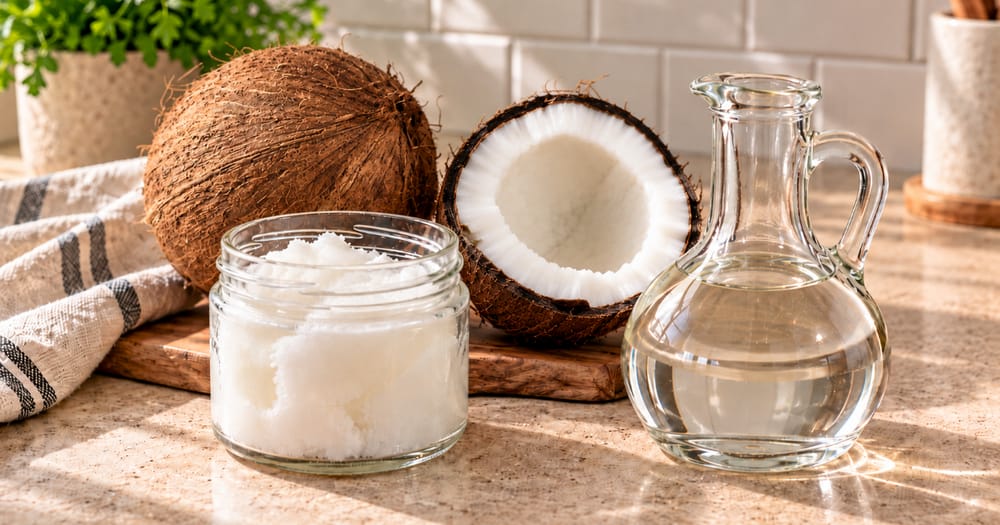
Regular coconut oil can turn solid when the temperature drops. So how does Liquid Coconut stay pourable, even in the fridge? The answer comes down to what's inside the oil and how it's made.
If you've ever kept a jar of coconut oil in your kitchen, you've probably noticed how it changes with the temperature.
On a warm day, the oil might be completely liquid. But when the kitchen gets cooler, that same oil can turn white and solid.
Nothing has gone wrong. That's simply how regular coconut oil behaves.
Now imagine putting a bottle of coconut oil in the refrigerator and finding that it's still liquid when you take it out.
It's still made from coconuts. So what's different?
The answer has to do with the fats naturally found in coconut oil and a process that separates the parts that become solid from those that remain liquid.
And once you understand how that works, it's easy to see why the difference can be useful in your kitchen.

THE QUICK ANSWER
Liquid Coconut is a fractionated coconut oil. It's made by cooling conventional coconut oil until some of its fat components begin to solidify, then separating those solid portions from the oil that remains liquid.
Coco-Nuts Liquid Coconut is made from that retained liquid portion. Its composition allows it to stay pourable, even in the refrigerator.

In This Guide
01. What Is Liquid Coconut Oil?
02. Why Does Regular Coconut Oil Turn Solid?
03. How Is Liquid Coconut Oil Made, and Why Does It Stay Liquid?
04. How Is Liquid Coconut Different From Regular Coconut Oil?
05. Does Liquid Coconut Oil Taste Like Coconut?
06. What Can You Use Liquid Coconut Oil For?
07. Does Liquid Coconut Oil Need to Be Refrigerated?
08. Could Liquid Coconut Fit Into Your Everyday Cooking?
09. Final Thoughts: Same Coconut, Different Consistency
10. Frequently Asked Questions
01. What Is Liquid Coconut Oil?
When most people think of coconut oil, they picture the familiar white oil that comes in a jar.
Depending on the temperature, it might be solid, soft, or completely liquid.
Liquid Coconut comes from the same source, but its fat composition is different.
Through a process called fractionation, the portions of coconut oil that begin to solidify when cooled are separated from those that remain liquid.
The liquid portion is retained.
This gives Liquid Coconut a different consistency from conventional coconut oil.
And it's not simply regular coconut oil that's been melted and poured into a bottle.
If you warm a jar of coconut oil, it will become liquid. But when it cools again, it can turn solid.
Liquid Coconut behaves differently because the balance of fats has changed.
To understand why, it helps to look at what happens inside that familiar jar.
02. Why Does Regular Coconut Oil Turn Solid?
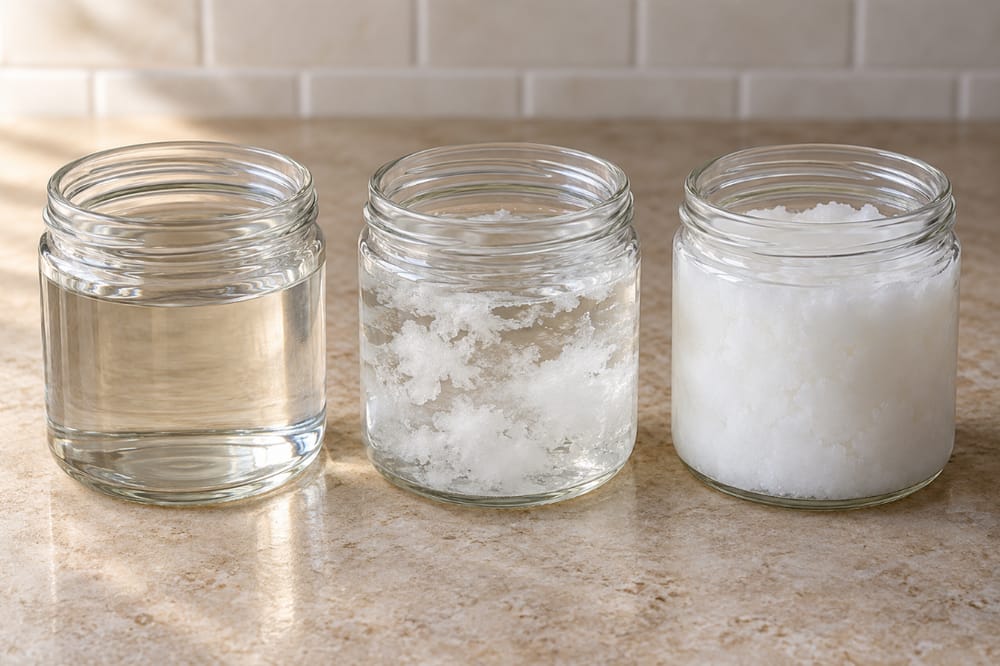
Coconut oil contains a mixture of fats, and they don't all melt or become solid at exactly the same temperature.
When the oil is warm enough, those fats are liquid.
But as the temperature drops, some begin forming tiny crystals. As more crystals develop, the oil becomes cloudy, thicker, and eventually firm or solid.
With conventional coconut oil, you'll often notice this change around 76°F (24°C), although it happens over a range of temperatures rather than all at once.
That's why a jar might be completely liquid during the summer but solid on a cooler morning.
Warm it again, and those crystals melt. The oil becomes liquid once more.
This is a normal physical change. It doesn't mean the coconut oil has spoiled.
The interesting part is that some components begin to crystallize while others are still liquid.
And because they behave differently, it's possible to separate them.
03. How Is Liquid Coconut Oil Made, and Why Does It Stay Liquid?
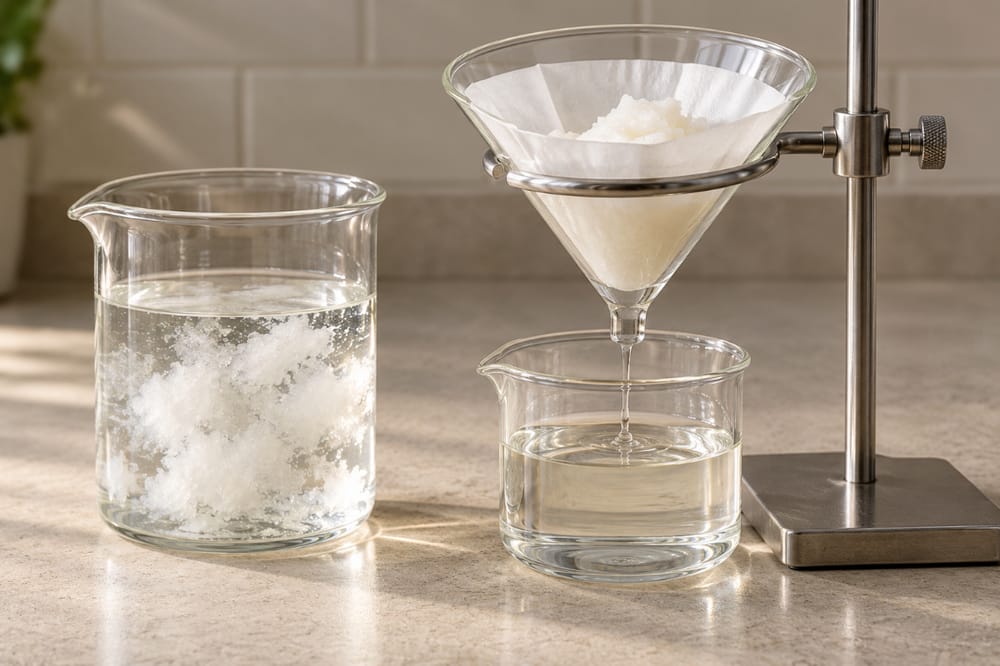
The process is called fractionation.
The name might sound complicated, but the idea behind it is fairly simple.
Start with conventional coconut oil in its liquid state.
As the temperature is carefully lowered, some fat components begin to form crystals and become solid. Others remain liquid.
Once that happens, the solid portion can be separated from the oil that's still liquid.
The liquid fraction is then retained.
That's how Coco-Nuts Liquid Coconut is made.
Rather than keeping the original mixture of fats found in conventional coconut oil, we're keeping the portion that remains liquid after separation.
The finished oil has a different composition, and that changes how it behaves when the temperature drops.
What makes the liquid portion different?
Coconut oil naturally contains different types of fatty acids, including medium-chain and long-chain components.
Conventional coconut oil typically contains about 57–63% medium-chain fatty acids, when C12 (lauric acid) is included in that group.
Coco-Nuts Liquid Coconut has a more concentrated medium-chain composition.
It contains 92.87% medium-chain triglycerides (MCTs), with the remaining 7.13% made up of long-chain triglycerides (LCTs).
The MCT portion contains a mixture of C6, C8, C10, and C12 components.
Those names simply describe different fatty-acid chain lengths. You don't need to memorize them.
The important thing is that fractionation changes the balance of fats in the finished oil.
The conventional coconut-oil estimate describes medium-chain fatty acids, while Coco-Nuts' figure is its declared MCT composition. They're related measurements, but not an exact like-for-like laboratory comparison.
And there's another detail worth understanding: it's the particular mix of fats, not just the total MCT percentage, that determines how the oil behaves in the cold.
With Coco-Nuts Liquid Coconut, that composition means you can take the bottle out of the refrigerator and pour what you need.
No melting required.
04. How Is Liquid Coconut Different From Regular Coconut Oil?
Both oils come from coconuts, but their composition gives them different characteristics.
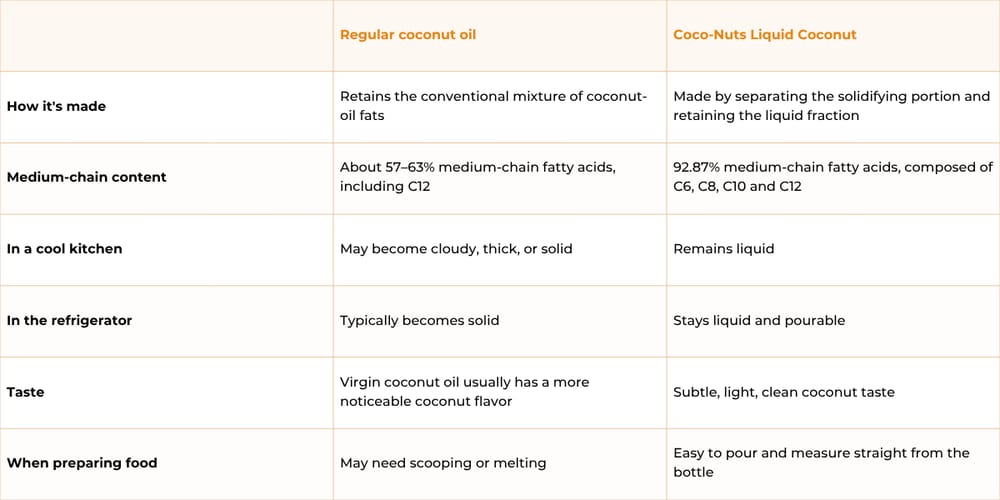
Neither consistency is automatically right for every recipe.

If you're making something that needs a solid coconut fat for texture, regular coconut oil may be useful.
But when you're measuring oil for baking or mixing a dressing, having an oil that's already liquid can make preparation simpler.
05. Does Liquid Coconut Oil Taste Like Coconut?
This is something I'd want to know before trying a new cooking oil.
If you've cooked with virgin coconut oil, you probably remember its coconut flavor.
That can be lovely in a recipe where you want the coconut taste to come through.
But imagine you're cooking zucchini with garlic and herbs, or making scrambled eggs with spinach.
You may want those familiar ingredients to remain the main flavors.
Coco-Nuts Liquid Coconut has a subtle, light, clean coconut taste.
It isn't flavorless, but the coconut note is gentle enough that it doesn't take over the meal.
That also makes it pleasant in sweet recipes with ingredients like banana, chocolate, vanilla, or cinnamon.
Of course, everyone experiences flavor a little differently.
If you enjoy a stronger coconut taste, virgin coconut oil may be just what you're looking for in a particular dish.
If you prefer something gentler for everyday cooking, Liquid Coconut offers another option.
06. What Can You Use Liquid Coconut Oil For?
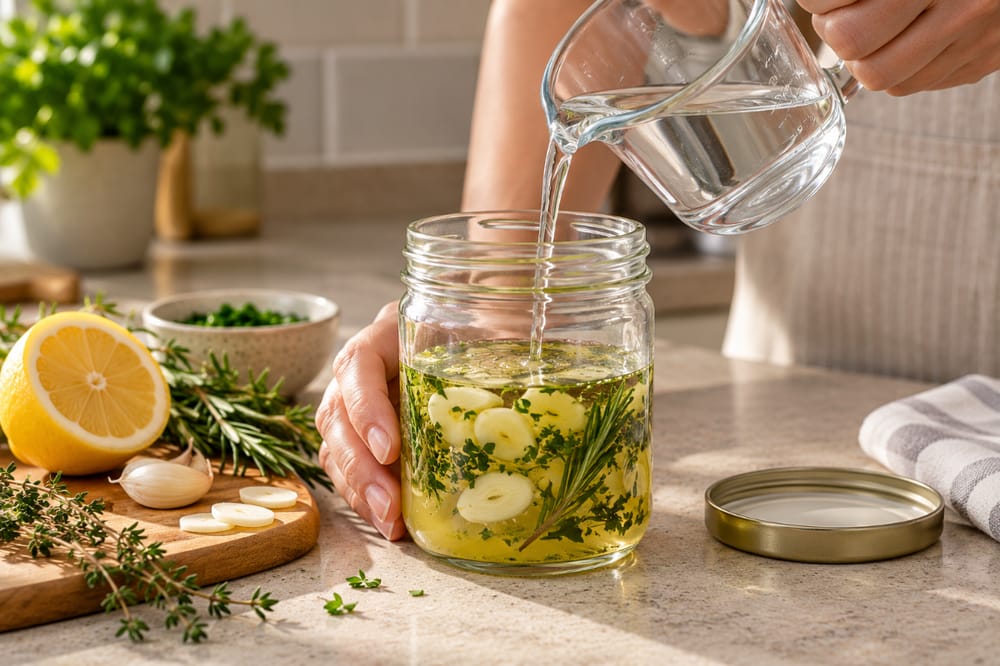
Think about the ways you use oil during a normal week.
Maybe you're making eggs in the morning, sautéing vegetables for dinner, or mixing a little oil into a cake batter.
You might also prepare a dressing or marinade ahead of time.
Liquid Coconut can fit into several of those everyday preparations.
Everyday pan cooking
Scrambled eggs, gently sautéed vegetables, and simple skillet dinners often use low to medium heat.
That's the kind of cooking Liquid Coconut is suited for.
You can pour a little into the pan and cook your ingredients at an appropriate temperature.
Its gentle coconut taste works with familiar savory ingredients without taking over the dish.
For very hot searing or deep-frying, choose an oil suited to those higher-temperature methods.
Baking
Maybe you're making banana bread, muffins, or brownies.
Many baking recipes call for liquid oil or melted butter because it's easy to mix into the batter.
Liquid Coconut is already pourable, so you can measure what you need without melting it first.
It can also replace butter at a 1:1 ratio by volume in suitable baking recipes, particularly when the recipe uses melted butter.
If a recipe depends on solid butter for flaky layers or for creaming with sugar, the swap isn't as straightforward.
It depends on what the fat is doing in the recipe.
Dressings and marinades
Imagine whisking oil with lemon juice, vinegar, mustard, or herbs to make a homemade dressing.
Or preparing a marinade and keeping it in the refrigerator until dinner.
With Liquid Coconut, the oil remains pourable even when chilled.
That can be especially useful when you're preparing food ahead of time.
The ingredients in a dressing may still separate, of course, so a quick shake or whisk might be needed. But you won't need to melt the Liquid Coconut first.
Roasted vegetables and other uses
You can also use Liquid Coconut to coat vegetables for suitable roasting, where its pourable consistency makes it easy to spread over the ingredients.
The actual temperature reached by oil on food isn't always the same as the oven setting, so cooking conditions still matter. Very intense heat, such as broiling, calls for a different approach.
Liquid Coconut can also be measured into suitable smoothies and other cold preparations.
The point isn't that every recipe needs the same oil.
It's that one ingredient can be useful in several different parts of your everyday cooking.
07. Does Liquid Coconut Oil Need to Be Refrigerated?
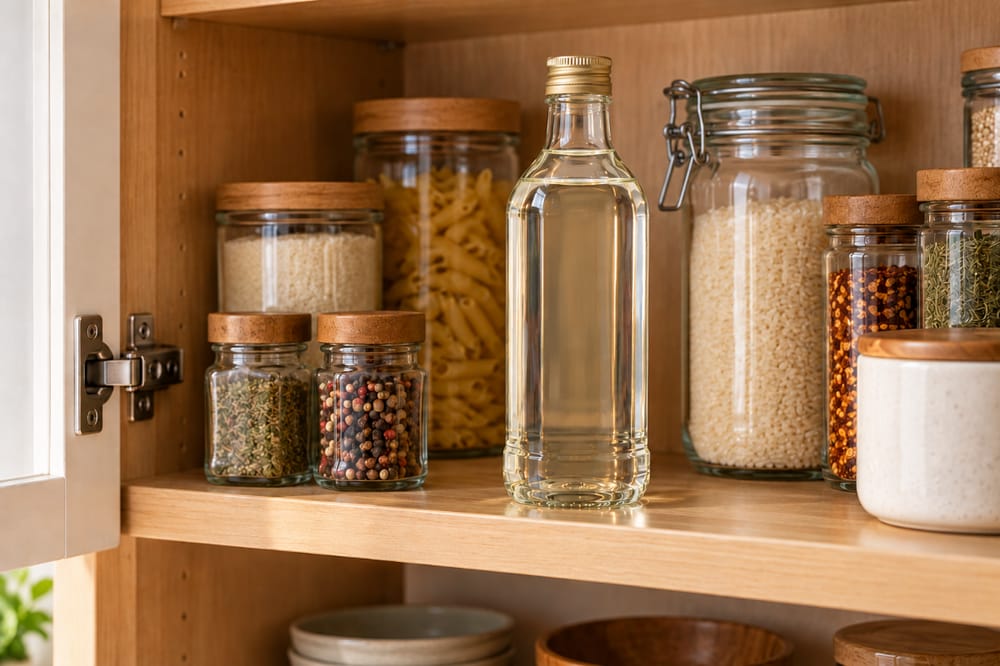
No. Coco-Nuts Liquid Coconut doesn't need refrigeration.
For everyday storage, keep the bottle tightly closed in a cool, dry place, away from direct sunlight and excessive heat.
Staying liquid in the refrigerator is a characteristic of the oil, not a storage requirement.
You can simply keep it with your other cooking oils and reach for it whenever you need it.
08. Could Liquid Coconut Fit Into Your Everyday Cooking?
I'd start with the meals you already enjoy making.
If you regularly cook eggs, prepare vegetables, bake simple recipes, or make your own dressings, you probably reach for oil in several different ways throughout the week.
A coconut-derived oil that's easy to pour and measure, with a gentle taste that works across different ingredients, can be a practical choice for those everyday tasks.
You may still prefer virgin coconut oil for a recipe that needs a stronger coconut flavor or a solid fat.
And for very high-heat cooking, you'll want an oil suited to that method.
But for the kinds of meals many of us prepare regularly, Liquid Coconut is worth considering.
If you'd like to learn more about the oil we've been discussing, you can explore Coco-Nuts Liquid Coconut.
09. Final Thoughts: Same Coconut, Different Consistency
Regular coconut oil can become solid when it's cool because some of its fat components crystallize as the temperature drops.
Fractionation separates those solidifying portions from the liquid fraction, creating an oil with a different composition.
That's why Coco-Nuts Liquid Coconut stays pourable, even in the refrigerator.
And when you're measuring ingredients, preparing a dressing, or cooking a simple meal, that difference can make things easier.
You don't need to remember all the chemistry. Just knowing how an ingredient behaves can help you choose where it belongs in your kitchen.
The Oil You Cook With Matters.
10. Frequently Asked Questions
No. Melting regular coconut oil changes its temperature, but not its original composition. It can become solid again when cooled.
Liquid Coconut is fractionated coconut oil. Its composition has been changed through separation, allowing it to remain liquid at temperatures where conventional coconut oil would normally solidify.
Often, yes, if the recipe calls for liquid or melted coconut oil and the flavor suits the ingredients.
But if the recipe depends on solid coconut oil to create firmness or a particular texture, the result may be different.
Check how the fat is being used before making the swap.
Yes, you can absolutely cook with Liquid Coconut. It's made for everyday cooking, including scrambled eggs, sautéed vegetables, and other meals prepared over low to medium heat.
You can also use it in suitable baking recipes, roasted vegetables, homemade dressings, and marinades.
Its light coconut taste and always-liquid consistency make it a convenient option for many of the meals you already prepare.
Yes. Depending on the separation and purification process, it's possible to produce an oil made entirely of MCTs, without LCTs.
Coco-Nuts Liquid Coconut has its own composition: 92.87% MCTs and 7.13% LCTs.
Its particular balance of fats allows it to remain liquid, even in the refrigerator.
Categorized under:

About the author
Lenny Gee from Coco-Nuts
Lenny Gee from Coco-Nuts
Lenny is the co-founder of Coco-Nuts. His approach starts with a simple belief: the oil you cook with matters. Though his blogs, he shares practical ideas about cooking oils, everyday meals, and simple kitchen upgrades that help home cooks make everyday cooking easier, lighter, and more enjoyable.
Keep Exploring the Kitchen
Keep Exploring the Kitchen
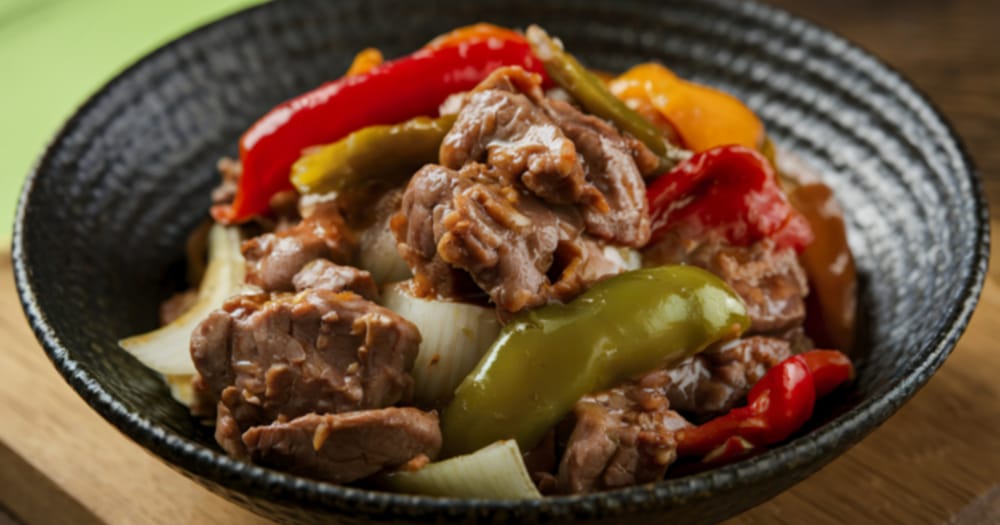
Pork Stir-Fry with Bell Peppers and Carrots
A quick pork stir-fry with colorful bell peppers, carrots, garlic, and a simple coconut aminos sauce for a fresh lunch or dinner.
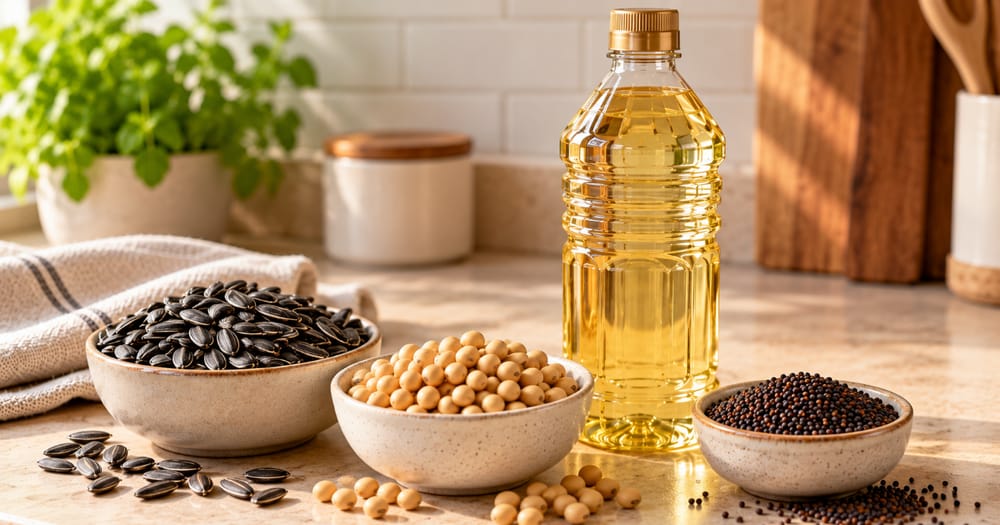
What Are Seed Oils? A Simple Guide
Seed oils are part of many familiar foods, but they're not all alike. Learn which oils belong to this group, how they're made, and what to consider when choosing the oil you cook with.

Best Oils for Everyday Cooking: How to Choose
Not sure which cooking oil belongs in your kitchen? Discover how common oils compare and learn what really matters when choosing one for the meals you already love.

Our Mission
To make better ingredient choices easier by creating thoughtful coconut products that replace conventional kitchen staples and fit naturally into the way people already cook.
Explore
© 2026 Coco-Nuts Inc. All rights reserved.
1520 55E Ave., Lachine, QC H8T 3J5, Canada

Ready to Upgrade the Way You Cook?
Join our FREE 7-Day Kitchen Upgrade Challenge and get one simple action each day to make cooking easier and everyday meals more enjoyable.
© 2026 Coco-Nuts Inc. All rights reserved.
1520 55E Ave., Lachine, QC H8T 3J5, Canada